

NATO/NSPA, PATROMIL/OPIA Member and Active EDF Applicant
Rheinbrucke is a Romanian engineering and technology integrator with more than three decades of documented activity in complex infrastructure, industrial modernisation, and digital systems. The Group operates across the entire project lifecycle, from concept and feasibility to design, construction, and systems integration, supported by authorisations, certifications, and programme credentials relevant to the defence sector. Rheinbrucke does not manufacture weapons or weapons systems. The Group’s contribution to the defence ecosystem lies in the engineering, digital, and research infrastructure that enables defence capability: facilities, production environments, data systems, software platforms, and participation in research programmes.
Strategic Capabilities
Romanian Engineering & Technology Integrator
Rheinbrucke serves the defence sector as an integrated partner across four complementary capability domains. We do not engage through standalone service lines, but through interconnected layers of a single delivery system.


SOFTWARE & AI
Infrastructure monitoring through digital twin technology. AI-assisted procurement doc. processing. GIS for military site analysis. LLM workflows for environments handling classified documentation.
CONTACTINFRA ENGINEERING
Design and construction of defence production facilities, military buildings, training infrastructure, and secure data environments, in accordance with NATO and international ISO standards.
CONTACTRESEARCH & DEVELOPMENT
Active participation in the EDF programme. Commitment to HORIZON Europe. National R&D authorisation for the defence industry. Submission of the ARCANA consortium within the EDF.
CONTACTEU PROGRAMMES
EDF (European Defence Fund) applicant since 2025/2026. Development of HORIZON Europe consortia. More than 50 completed EU-funded projects in infrastructure, energy, and digital systems.
CONTACTStrategic Context
Romania’s Defence Investment Cycle and the European Framework
Romania’s defence modernisation agenda has accelerated significantly since 2022. National defence spending has exceeded NATO’s 2% of GDP benchmark, while structural investments in national defence industrial capacity, military infrastructure, and digital systems have created sustained demand for qualified engineering and technology partners operating according to international standards. The framework of the NATO Support and Procurement Agency (NSPA), where Rheinbrucke is a registered supplier, provides the procurement architecture for the delivery of Allied capabilities.
At European level, the European Defence Fund (EDF) is the most significant investment instrument in defence research and industrial development in the history of the Union. EDF calls require multinational consortia bringing together research institutions, technology developers, and industrial partners capable of delivering from prototype to implementation. Rheinbrucke operates in this environment as an engineering and technology integrator.
Software & AI Capabilities
Technology
Rheinsystems, the technology development company within the Rheinbrucke Group, develops software and AI solutions on dedicated infrastructure, including high-performance AI computing servers operated within the Group’s own facilities. The capabilities outlined below are under active development and have direct applicability to the defence sector.
CONTACTDefence procurement environments involve large volumes of structured and unstructured documentation that must be classified, analysed, and processed under strict procedural requirements. Rheinsystems is developing AI-assisted document processing pipelines capable of ingesting, structuring, and analysing procurement documentation while reducing the manual processing burden. The system is designed for integration with existing procurement workflows and is being developed with awareness of both Romanian public procurement legislation (Law no. 98/2016) and European defence procurement frameworks.
CONTACTApplying large language models to defence workflows requires on-premise deployment, data isolation, access control integration, and operation within information security regulations. Rheinsystems operates local LLM inference infrastructure within the Group’s own facilities and develops workflow architectures aligned with Rheinbrucke’s existing authorisation to handle classified information at the service secret level, issued by the Romanian Intelligence Service (SRI) through as the Designated Security Authority.
CONTACTRheinsystems is developing a digital twin platform for the continuous monitoring of complex physical infrastructure. The system maps real-time operational parameters onto models of physical facilities, enabling condition monitoring, predictive maintenance planning, and anomaly detection without disruptive physical inspections. For defence applications, this capability supports the management of military installations, production facilities, and critical infrastructure assets where operational continuity is mission-critical.
CONTACTheinsystems is developing a GIS platform with analytical layers applicable to defence, including infrastructure mapping, terrain modelling, and spatial data integration. The platform builds on Rheinsystems’ existing GIS development programme for urban planning (PUG/PUZ workflows), adapted to the data-precision and access-control requirements specific to military site analysis applications.
CONTACTRheinsystems’ software development programme for 2026–2027 includes an expanding focus on AI capabilities applicable to defence, aligned with its active participation in the European Defence Fund programme. Specific capability development tracks are being pursued in parallel with EDF consortium activities. Further capability announcements will be made as development reaches appropriate disclosure thresholds.
CONTACTResearch and Development
Research, Development & Participation in European Programmes
Rheinbrucke holds national authorisation to conduct research and development activities in natural sciences and engineering for the defence industry, issued in accordance with the Romanian regulatory framework governing participation in the defence sector. This authorisation places the company within the formal institutional structure of Romania’s national defence industrial base. In 2025, Rheinbrucke became an active applicant to the European Defence Fund, the European Union’s principal instrument for the co-funding of collaborative defence research and capability development. Rheinbrucke is a participating member of the ARCANA consortium, which has submitted a project application under the EDF programme.
Rheinbrucke’s R&D (C&D in română?) commitment also extends to the HORIZON Europe framework, where the Group is developing consortium relationships with European research and technology organisations. Membership in PATROMIL and OPIA, the representative organisations of Romania’s defence industry, provides institutional access to the national defence R&D ecosystem and supports engagement with programmes of the Ministry of National Defence.
ARCANA CONSORTIUM
European Defence Fund
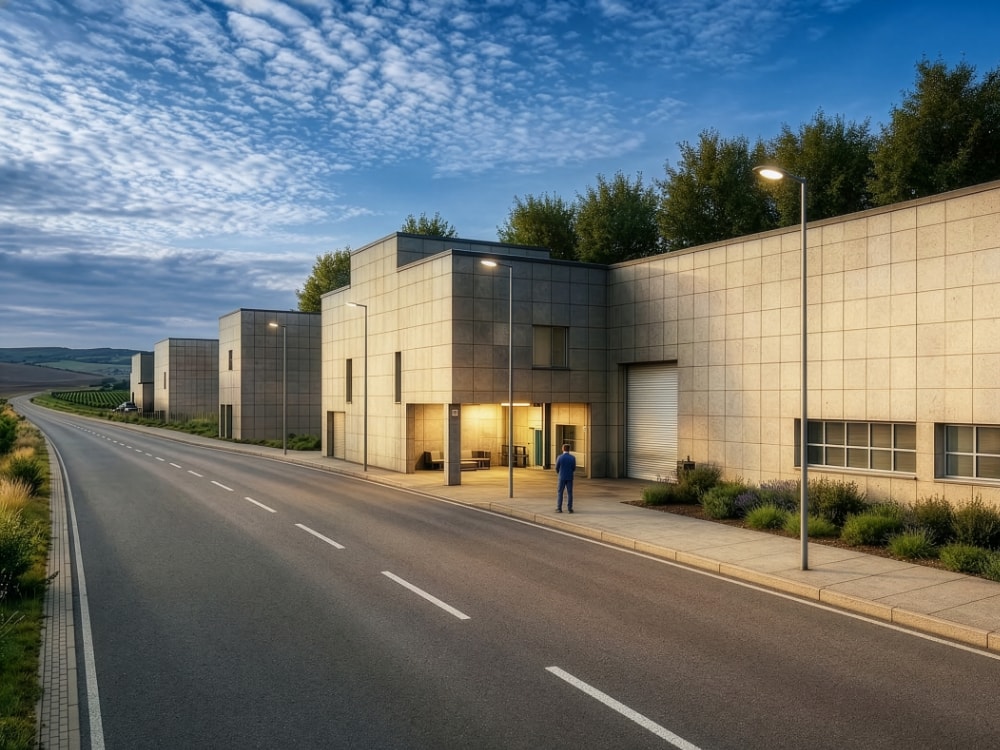
Facility Modernisation (Cugir – ROMARM)
Modernisation and expansion of the ammunition production infrastructure capacity to NATO standards at the Cugir Mechanical Plant, operated by ROMARM. Rheinbrucke’s scope included designing modernisation solutions for a high-security military industrial facility, conducting technical analysis for the expansion of ammunition production capacity, adapting the production infrastructure to NATO safety and technological standards, carrying out geotechnical and seismic analysis of the facility, and integrating modern production line configurations.

Mangalia Shipyard Modernisation Study
Rheinbrucke’s scope included a feasibility and modernisation study for Mangalia Shipyard, covering production infrastructure supporting military naval vessels, including frigates, corvettes, and mine countermeasure ships. The project addressed the modernisation of production infrastructure and technical workflows, the improvement of energy efficiency across more than 10,000 square metres of workshop and production space, the physical security of the industrial perimeter, and the replacement and reconfiguration of workshops to current technical standards.
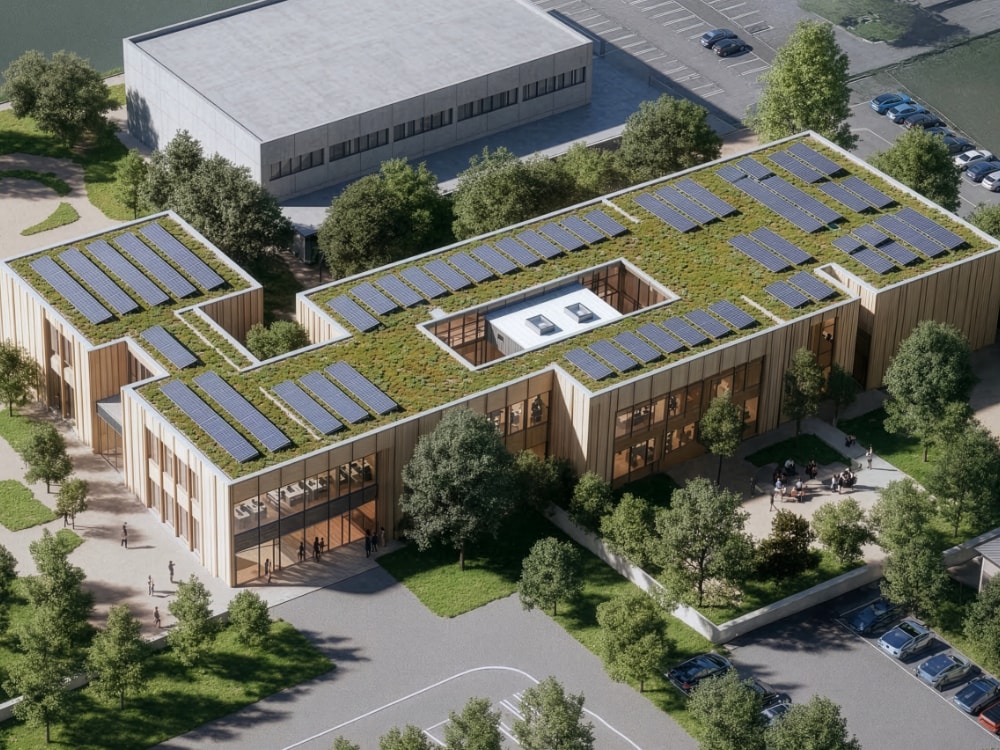
Romanian Land Forces HQ – NZEB Building
Design and delivery of a Nearly Zero Energy Building for the headquarters of the Romanian Land Forces, integrating high-performance building envelope specifications with the operational and security requirements of a military command environment. The project required the adaptation of NZEB design methodologies to military operational constraints, as well as the integration of energy systems configured for long-term infrastructure resilience under critical, dynamic, complex, secure, and sustainable operational conditions.
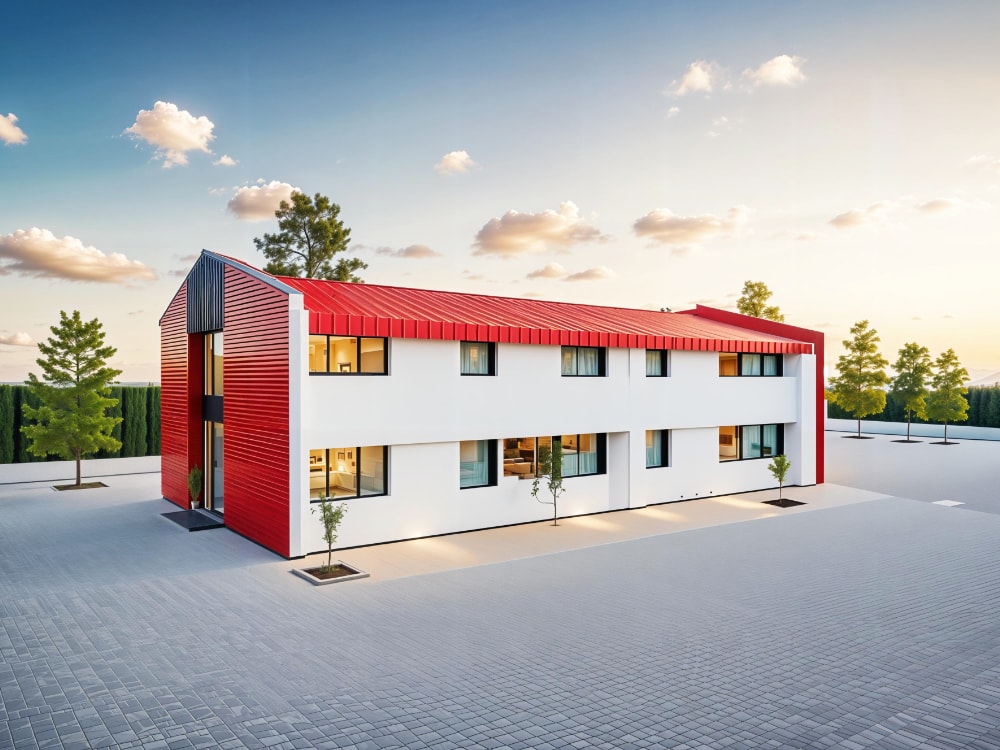
Banat Inspectorate for Emergency Situations
Design and engineering of a strategic training facility for emergency response personnel serving Romanian and Serbian operational organisations. The facility incorporates administrative and accommodation buildings, training towers, simulation environments, and specialised training infrastructure for scenarios involving fire intervention, hazardous materials, tankers, and vehicles. Its multinational scope and operational sensitivity demonstrate Rheinbrucke’s delivery capability in multi-jurisdictional security-sector environments.
Partnerships and Programmes
Current Activity
ARCANA Consortium
Rheinbrucke is a participating member of the ARCANA consortium, which has submitted a project application under the EDF programme. No details are disclosed regarding the scope of the ARCANA project, its technical domain, or the composition of the consortium.
NATO Agency (NSPA)
Registered supplier within the NATO Support and Procurement Agency (NSPA), eligible for NATO-funded procurement, under NCAGE Code 1JS5L. This is the NATO Commercial Code and Government Entity code used for suppliers.
PATROMIL and OPIA
Active member of the Romanian Defence Industry Association and the Employers’ Organisation of the Defence Industry, with access to national defence industrial programmes.
European Defence Fund (EDF)
The EDF is an EU instrument (2021–2027) designed to stimulate research and development in common defence technologies. It promotes interoperability, innovation, and the competitiveness of the European defence industry, while reducing fragmentation.
HORIZON Europe
Consortium development is currently underway with European research and technology partners, as well as within bilateral programmes where Rheinbrucke’s specific competences are complementary.
Defence ECOSYSTEMS
The Group is actively seeking partnerships with European defence companies, research institutions, and technology developers for EDF, HORIZON Europe, and bilateral programmes.
Certifications and Authorizations
Compliance Framework
Quality Management Systems – architecture, engineering, construction, and project management services. This standard covers the requirements addressed to organisations seeking to enhance client satisfaction through effective quality processes, continuous improvement, and evidence-based decision-making. Built on seven quality management principles, including customer focus, leadership, and the process approach, it supports alignment with global standards and facilitates trade and compliance across industries.
Environmental Management Systems – all project delivery and operational activities. This standard provides a framework for organisations to minimise their environmental impact, comply with legal requirements, and improve sustainability. It places emphasis on leadership, planning, support, operations, performance evaluation, and continuous improvement. Through its implementation, the organisation improves its environmental performance, reduces waste and emissions, and promotes the wider adoption of these principles through demonstrated environmental responsibility.
Occupational Health and Safety Management Systems – all on-site and operational activities. This standard sets out the requirements for an occupational health and safety management system, helping organisations prevent work-related accidents and incidents. It places particular emphasis on leadership, worker participation, risk-based thinking, and continuous improvement, in line with international best practices. Its implementation supports legal compliance and promotes a safer workplace culture.
Information Security Management Systems – data management, access control, and cybersecurity across the Group’s operations. This standard aligns information security management system requirements in Romania with global best practices. It provides a framework for establishing, implementing, maintaining, and continually improving such a system in order to protect organisational information. Its implementation demonstrates compliance in strengthening data protection, with a strong emphasis on risk-based approaches, management commitment, and the continuous improvement of information security.
Medical Devices – Design and Development (Rheinsystems, software applications for healthcare). This is the international standard for quality management systems specific to medical devices, ensuring consistency in design, development, production, and distribution. It enhances patient safety, reduces risk, and supports regulatory compliance across global markets. By aligning with this standard, the organisation streamlines time to market, improves operational efficiency, and demonstrates a clear commitment to quality.
Welding Procedure Qualification – structural and industrial construction contracts. This is the international standard for the qualification testing of welding procedures for metallic materials. It sets out the requirements for qualifying welding procedure specifications using arc and gas welding processes for steels and nickel/nickel-alloy materials, ensuring alignment with current technological and safety standards, particularly in industrial applications such as pressure vessels and structural components.
Execution of Steel and Aluminium Structures – structural metal elements. This European standard specifies the requirements for the execution of steel and aluminium structures. It applies to fabrication and assembly processes, defining the essential performance criteria and conformity assessment procedures. It establishes requirements for factory production control and for the structural characteristics required for placing such elements on the market, including strength, stability, and durability, thereby ensuring the safety and quality of structural components such as beams, columns, stairs, platforms, and welded structures.
Registered supplier within the NATO Support and Procurement Agency (NSPA), eligible for NATO-funded procurement under NCAGE Code 1JS5L. The NATO Commercial and Government Entity (NCAGE) code, used for manufacturers and suppliers in the defence sector and for non-US companies working with NATO or the US Department of Defense, is required to authorise a non-US company to bid for NATO contracts or participate in defence-related contracts.
Institutional Member of the Romanian Defence Industry Association, with access to national defence industrial programmes. PATROMIL aims to support national security, strengthen industrial capacity, and ensure Romania’s active contribution to NATO and European Union defence and security structures. Through strategic investment, industrial modernisation, and multilateral cooperation, PATROMIL seeks to position Romania at the centre of a sovereign and effective European defence architecture.
Active applicant to the European Defence Fund and participant in the ARCANA consortium submission under the EDF framework. The European Defence Fund (EDF) is an EU instrument for the 2021–2027 period designed to stimulate research and development in common defence technologies. It promotes interoperability, innovation, and the competitiveness of the European defence industry, while reducing fragmentation and supporting the EU’s strategic autonomy. Through the EDF, the European Union aims to build a more integrated defence industry capable of responding to current and future security needs.
Authorisation for handling classified information at the service secret level, issued by the Romanian Intelligence Service (SRI), acting as the Designated Security Authority. This official authorisation allows cleared personnel to access, handle, and protect sensitive information within public or private institutions. It is granted following the verification of employees’ trustworthiness and competence, with access restricted according to professional need-to-know. It is essential for preventing information leaks and maintaining the integrity of critical data.
Authorisation for Research and Development in Natural Sciences and Engineering for the defence industry, issued by the Ministry of Economy, Digitalisation, Entrepreneurship and Tourism, subject to compliance with environmental protection regulations and the relevant sector-specific authorisations. The authorisation covers fundamental research, applied research, and experimental development in natural sciences and engineering, supporting innovation and technological advancement within regulated frameworks, alongside the obtaining of relevant environmental approvals and fulfilment of legal requirements.
Design of fire detection, alarm, extinguishing, and smoke ventilation systems: authorisation for the design of fire detection, alarm, and alert systems and of fire limitation and extinguishing systems; authorisation for the design of ventilation systems for the evacuation of smoke and hot gases, excluding naturally organised systems; and authorisation for the installation and maintenance of fire detection, alarm, and alert systems.
Authorised supplier of railway infrastructure and railway systems, holding authorisation for design and consultancy services, as well as for the provision of topographic, geotechnical, and hydrogeological studies in the field of railway infrastructure. Also authorised by the Romanian Railway Authority for the construction, maintenance, repair, modernisation, and strengthening of railway-specific buildings, including those housing equipment for the control, management, and signalling of rail traffic and related installations, except for installations under the jurisdiction of other authorities.
Certified for the design and execution of electrical installations, both external and internal, for civil and industrial buildings and spaces, including overhead and underground connections, at a nominal voltage of 0.4 kV. Authorised for the design and execution of natural gas distribution systems and biogas/biomethane production and storage installations operating under medium, reduced, and low-pressure regimes. Also authorised for the design and execution of natural gas utilisation installations under medium, reduced, and low-pressure regimes.
Defence Sector
Contact Form
For any specific information, such as technical support for projects, quotes, or consultancy services, please complete the contact form. Our team will handle your request and respond as soon as possible. At Rheinbrucke, the privacy of your data is extremely important to us, and we are committed to protecting it by taking all necessary measures. In the “Data Policy” section, we describe what personal information we collect from you, the purpose and legal basis for processing it, with whom it is shared, and your rights. All information received will remain confidential. For more details regarding the data policy of this website, please visit the Rheinbrucke GDPR section.